Lead Research, Practice & Change with a PhD in Education
A doctorate is the highest credential for leaders, researchers, and innovators in education. At George Mason University's College of Education and Human Development (CEHD), our PhD in Education program is designed to be a transformative experience, empowering you to advance knowledge in academia or to lead significant change in the field. We recognize that the path to influence is no longer linear. That's why our program is built on a flexible foundation of personalized mentorship and interdisciplinary study, designed to bridge the gap between rigorous research and real-world professional practice.
This is not a one-size-fits all degree. From day one, you will work with world-class faculty to design a course of study that reflects your distinct professional interests and career goals. Whether you aim to join the faculty at a post-secondary institution or lead a federal agency, our curriculum balances advanced theory with experiential learning. Our mission is to ensure you graduate with a compelling professional portfolio, not just a transcript, ready to address pressing educational challenges and promote equity as a leader in your chosen field.
Why Choose George Mason CEHD
Hands-on research and teaching. Master the connection between theory and practice, positioning you to advance research-informed solutions to today's most complex educational challenges.
Support for working professionals. Engage in on-campus/blended learning with late-afternoon or evening course offerings, without stepping away from your career.
Strong professional outcomes. Launch the next stage of your career, preparing for high-impact positions as academic faculty, government researchers, private consultants, or K-12 district leaders.
Accessible and affordable. Benefit from a 15% tuition discount for Virginia educators, making advanced study within reach.
Professional portfolio development. Build a robust CV while you learn, with supported experiences in presenting at conferences, co-teaching university courses, and reviewing for scholarly journals.
Equity and innovation at the core. Join a scholarly community deeply committed to advancing equity through excellence in research, teaching, and service.
What Sets Us Apart?
Unmatched academic flexibility. Choose from 15 distinct pathways—including 12 specializations and 3 concentrations—to build a truly tailored degree.
Research intensity and breadth. Gain advanced training in both quantitative and qualitative methods and work to address problems of practice in collaborative and cross-disciplinary research teams.
Personalized mentorship. Each student designs an individualized plan of study supported by a dedicated faculty advisor, ensuring your coursework aligns directly with your career goals.
- Prime location for educational impact. Leverage George Mason's proximity to Washington, DC, Northern Virginia, and Maryland for experiential learning in education policy, leadership, and research.
Specializations (self-selected interdisciplinary options)
Concentrations (prescribed curriculum)
The mission of the PhD in Education Program is to empower scholars and leaders to think critically, advance research-informed practice, address pressing challenges, and promote equity through excellence in research, teaching, and service in their chosen fields.
Each student in the PhD in Education Program is mentored by faculty in the development of their own personalized program of study that fosters their ability to:
- Demonstrate knowledge of significant theories, developments, and practices in one's chosen area of study
- Understand, utilize, and interpret basic principles, ethical practice, and methodologies of educational research design and data analysis
- Effectively communicate both orally and in writing to a variety of professional audiences
Supported professional experiences and internships beyond required coursework support mastery of these competencies, including:
- Attending and/or presenting your scholarly work at professional conferences to researchers, policymakers, and practitioners
- University teaching and/or co-teaching experiences in professional areas of expertise
- Supervising pre-service teachers
- Writing, editing, and reviewing for scholarly journals
- Research apprenticeships and assistantships
- Supported independent research in an area of professional interest
- Internships unique to the individual’s area of study
- Building a professional portfolio
The PhD in Education is awarded after the successful completion of:
- Coursework
- A comprehensive portfolio assessment
- A written dissertation
- An oral dissertation defense
Are you ready to expand your impact in the field of education?
A PhD in Education from George Mason can help you reach that goal! Our accomplished faculty can help you leverage your existing expertise in the field of education and deepen your toolkit of professional knowledge and skills that will take your career to the next level of influence.
Our graduates have attained consequential professional positions such as:
- Academic faculty at post-secondary institutions
- Leadership and research positions in federal and state government, post-secondary institutions, research organizations, and non-government agencies
- Analysts and consultants with private companies, political advocacy groups, education or research think tanks, and professional associations
- School, district, and statewide leadership positions in major preK-12 school districts, technical assistance centers, and other informal educational agencies
- Curriculum and instructional materials developers
Our flexible student-centered program structure allows each student to design a personalized, interdisciplinary program of study that helps them to become outstanding educational researchers, practitioners, and leaders in their respective fields. Our faculty have strengths in:
Theoretical & Applied Research
- Choose from a wide range of advanced quantitative and qualitative research methods coursework options
- Have the opportunity to gain research experience on projects funded by federal agencies, including the Institute for Education Sciences and the National Science Foundation
Advanced Teacher Preparation
- Choose from a wide range of teaching and teacher preparation coursework and internship options, including opportunities to co-teach university courses with faculty and supervise teacher internships
- Receive advanced training in online teaching and learning
Education Leadership & Policy
- Choose from a wide range of coursework and internship opportunities in leadership and policy fields, both national and international
- Have unique opportunities for experiential learning due to proximity to Washington DC and several of the largest school systems in the country
Movement & Sport Sciences
- Choose an intensive Kinesiology program with opportunities for experiential learning in state-of-the-art movement labs.
- Or, create a custom program of study in fields related to movement and sport sciences, including teaching in physical education and sport management
Visit our Frequently Asked Questions and Answer Page
Frequently Asked Questions
Attend an Information Session
The PhD in Education Program periodically conducts information sessions to acquaint applicants with our program and the admissions process. Information sessions include an overview of the PhD in Education Program followed by breakout sessions with faculty who can answer questions about professional specialization areas. Scheduled sessions are listed at the top of this page.
*WMST 890 is pre-approved for HE Concentration students; all other students need permission from their Program Advisory Committee and the Director of the PhD in Education Program.
Specializations
Most students specialize in a single area of study with additional coursework in a secondary area of interest. However, it is also possible to have a dual specialization in two areas of interest or to work with faculty mentors to self-create a unique interdisciplinary specialization. Specialized coursework often includes individualized internship experiences.
Concentrations
Students in a concentration have identified an area of study to engage in a targeted focus of study. Concentrations have pre-determined coursework that includes application and/or internship experiences.
Students have the option to add a graduate certificate to their PhD in Education degree. Information about these options can be found here:
*HE 999 is an option only for HE Concentration students.
| TERM |
CLASS START OPTIONS |
APPLICATION DEADLINE |
ADMISSION INTERVIEWS |
| Fall |
August* |
November 15th (Early admission**) |
Mid-December |
| August* |
February 15th |
Mid-March |
| August |
April 15th |
Mid-May |
| August |
June 15th |
Mid-July |
| Spring |
January |
October 1st |
Mid-November |
| January |
November 1st (space available) |
Mid-November |
*Students admitted in this application cycle can opt to begin courses in the summer term that begins in May.
**Applications received by the early admission deadline will receive first consideration for available merit-based multi-year funding package offers. Funding package offers will be awarded in subsequent application cycles if funds are available. A range of additional funding opportunities are available regardless of acceptance term (see PhD in Education funding page).
For more information and to apply, visit the admissions website.
All application materials must be submitted through Mason’s online graduate application. In addition to meeting general university admissions requirements, applicants will need to satisfy the requirements below.
Application Form and Fee:
Resume or Curriculum Vita:
- The resume, or curriculum vita, should reflect experiences and accomplishments foundational for a PhD in Education Program. It should be free of grammatical errors.
Goals Statement:
- The goals statement should be 750-1000 words and describe the academic and career goals that a PhD in Education will enable you to attain.
- We recommend applicants be specific in describing their past experiences related to the intended professional specialization as well as personal and professional aspirations.
- Applicants should identify their intended primary professional specialization or concentration within the PhD program. If there are specific faculty members within that specialization that the applicant is interested in studying with, this should be mentioned as well (this is not required).
Transcript:
- Applicants can upload their unofficial transcripts for application review. Please refer to the Office of Graduate Admissions for specific requirements.
GRE (Graduate Record Exam) scores:
- GRE scores must be from an examination taken within the last five years. Official test scores must be received by George Mason by the application deadline. This requirement cannot be waived.
- GRE scores are optional for the Concentration in Education Leadership and the Concentration in Higher Education.
Three Letters of Recommendation:
- Recommendations should be professional or academic in nature.
- Applicants should follow the instructions included within the online application to submit the recommendation form directly to their recommender. Mason does not accept paper recommendations.
- Applicants should ask recommenders to comment on their experiences and accomplishments that are indicators of aptitude for doctoral study.
Students with International Education Credentials:
Supplemental Materials (optional):
- Supplemental materials might include writing samples of previous research reports, including published works.
- A description of evidence of aptitude to successfully complete required statistics coursework, including non-degree coursework taken prior to admittance into the PhD in Education Program.
All required materials must be in the admissions office by the admission deadline to ensure proper processing. If you are missing parts of the required application materials, your application is incomplete and will not be considered. While there is a short grace period for official GRE scores to arrive from ETS for applicants who have taken the exam prior to the admissions deadline, applicants can also submit unofficial GRE scores in the supplemental materials section of the application to ensure that there is not a delay in the review of their application.
Program Eligibility
Applicants must have conferred a master’s degree prior to beginning coursework in the PhD program. Three years of relevant work experience may be required for specific professional specializations. Applicants must have a minimum 3.00 GPA on a 4.00 scale in baccalaureate study. The GPA requirement may be higher for some graduate programs. The university, at its discretion, may, in evaluating the meeting of this requirement, additionally consider the difficulty of the baccalaureate degree, relevant work experience, any/or other evidence of ability to succeed in graduate study.
The Ph.D. in Education admissions committee conducts a holistic review of all components of each candidate's application, which includes GRE scores (optional for Concentration in Education Leadership and Concentration in Higher Education), GPA, fit with the program faculty research, publications, goal statement, relevant work experience and educational background or other evidence provided that supports the candidate’s qualifications. In addition, an interview with program faculty is required for admission.
| TUITION CLASSIFICATION |
COST PER CREDIT |
| Virginia Resident |
$779.00 (includes MSF*)
|
| Non-Virginia Resident |
$979.00
(includes MSF*; discounted from $1,641.50)
|
| VA Resident and PK-12 VA Educator enrolled in a CEHD graduate program** |
$662.00
(includes MSF*)
|
| CEHD Course Fee |
$25 - $84 |
| Total Cost for Virginia Residents per Credit |
$804.00 - $944.00 |
| Total Cost for Non-Virginia Residents per Credit |
$1,004.00 - $1,185.00 |
| Total cost for VA Resident and PK-12 VA Educator enrolled in a CEHD graduate program** |
$687.00 - $815.00 |
Graduate New Student Fee
(non-refundable, one-time fee) |
$60 |
Please Note: Refer to the Students Accounts Office website for more information on tuition and fees. Internship courses will incur a higher course fee to fund on-site assistance involving intensive clinical training/supervision.
*Mandatory Student Fee (MSF): $169.00
**VA state residents who are eligible must apply for the 15% PreK-16 VA Educators Discount in order to take advantage of the lower tuition. Eligible students receive 15% off the total tuition and mandatory student fee.
There are a wide range of sources to help you fund your doctoral study, including:
- Loans and scholarships available through the Office of Student Financial Aid.
- Graduate research or teaching assistantships, tuition waivers, and fellowships available through CEHD, faculty grants, and the University Graduate Division. Visit the PhD in Education funding page for more information.
- Tuition reimbursement options available through many school districts. Speak to your employer for more information.
Initial Advisor
At the time of admission, students in the PhD in Education Program are provided with an initial point of contact from their specialization to serve as a temporary advisor. After no more than two semesters of coursework, students select a chair for their Program Advisory Committee to assist them in forming a program advisory committee.
Program Advisory Committee
The first committee, the Program Advisory Committee, advises the student through the development of a program of study, completion of all pre-dissertation coursework, and defense of the Comprehensive Portfolio Assessment required to advance to candidacy.
Doctoral Dissertation Committee
A second committee, the Doctoral Dissertation Committee, advises the student in the preparation, submission and defense of the PhD in Education dissertation
This document contains the following sections:
SECTION I: INTRODUCTION
- Comprises a description of the program including its structure, program evaluation, and resources for students.
SECTION II: PROGRAM GUIDELINES POLICIES AND PRACTICES
- Comprises a synopsis of key applicable George Mason policies and practices as well as additional requirements and protocols of the PhD in Education degree including (a) academic integrity, (b) appeals, (c) committees, (d) continuous enrollment and time limits, (e) course requirements, (f) credit transfers, (g) exiting the program, and (h) graduation requirements.
SECTION III: PROGRAM OF STUDY GUIDELINES
- Comprises requirements for students constructing their program of study including (a) course level requirements, (b) types of course options, (c) required program of study components, and (d) program-specific course requirements.
SECTION IV: PORTFOLIO GUIDELINES
- Comprises requirements for documenting evidence of student learning and knowledge development throughout the pre-dissertation phase of doctoral coursework including (a) the program advisory committee, (b) the portfolio process, (b) Portfolio I, (c) Portfolio II, and (d) Portfolio III/Comprehensive Portfolio, and (e) Portfolio Rubrics
SECTION V: DISSERTATION GUIDELINES
- Comprises important information related to (a) the dissertation committee, (b) both dissertation format options: traditional and manuscript, (c) dissertation proposal, (d) institutional review board approval, (e) dissertation defense, (f) final dissertation review, and (g) dissertation submission to the university library.
This page contains forms for the program, including (a) program of study and related forms, (b) individualized course forms, (c) portfolio forms, (d) dissertation forms and resources, and (e) funding applications.
This page contains information related to (a) college-funded research assistantships, (b) grant-funded employment opportunities, and (c) other funding opportunities within and outside George Mason.
This page allows you to search all courses offered in the PhD in Education Program and filter by: (a) specialization, (b) content interest area, and (c) semester that courses are typically offered.
This page allows you to access a repository with a range of resources and extended learning opportunities to support you in your doctoral journey.
Important Deadlines & Upcoming Events
Dissertation Defense:
- Spring: last Friday in March
- Summer: last Friday in June
- Fall: last Friday in October
Student Organizations
PhD in Education Student Organization (PESO)
Graduate and Professional Student Organization at George Mason University (GAPSA)
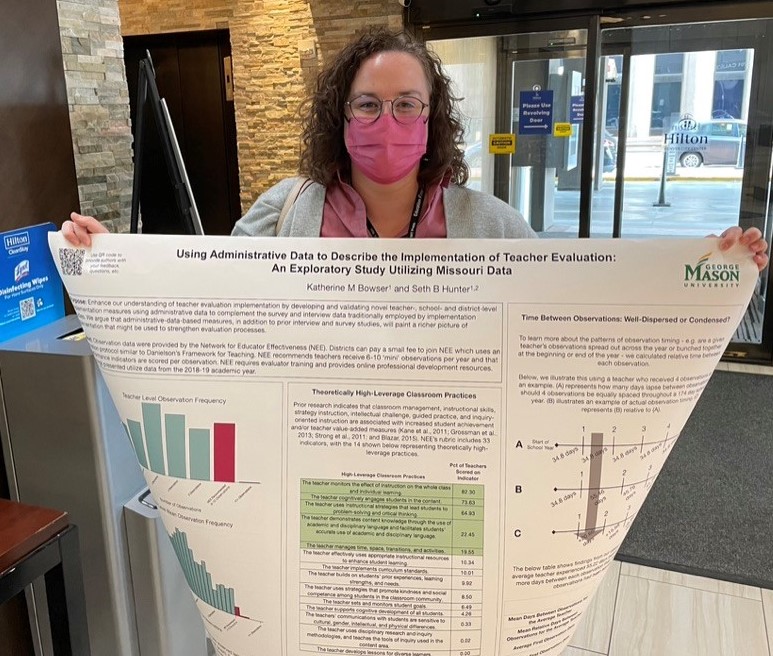
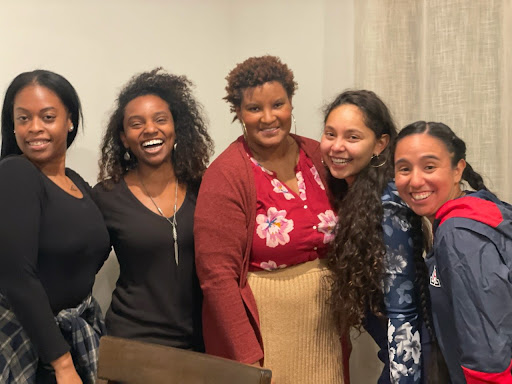
Mason was well-represented at the 2022 Association for Education Finance and Policy’s annual meeting, the nation’s preeminent conference focused on education policy research. Drs. Sam Viano and Seth Hunter and two of their Ph.D. students, Natalie Truong and Katherine Bowser, presented original research concerning student safety, teacher working conditions, and teacher evaluation measurement and implementation. (pictured: Katherine Bowser)This photo includes a few leaders on the Student & Early Career Council (SECC) representing the Society for Research in Child Development. (pictured from left to right: Dr. Ashley Stewart, GA State University; Dr. Michelle Brown, University of South Carolina; Amber B. Sansbury, PhD Candidate at GMU; Dr. Josefina Bañales, University of Illinois-Chicago; and Dr. Lorena Acevez, Child Trends)

 Angela Miller
Director
Angela Miller
Director Joan Stahle
Program Manager
Joan Stahle
Program Manager